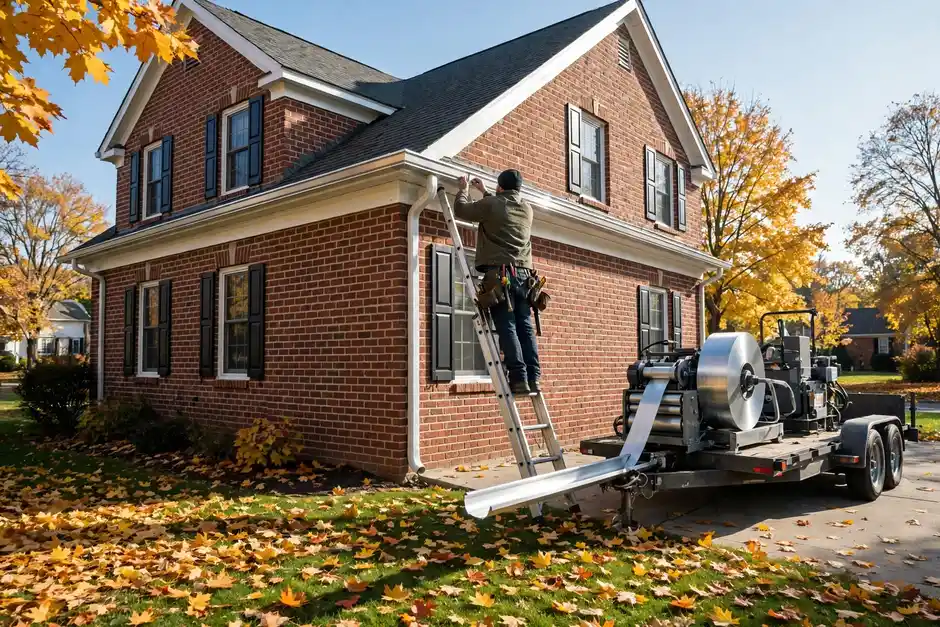
New gutters, formed for the roofline
Seamless Gutter Installation in Indianapolis
Seamless gutter installation in Indianapolis replaces a failing run — or a full system — with gutter formed in one continuous length for each eave, so the only joints sit at corners and outlets. This page covers new installation and replacement together, including 5-inch and 6-inch sizing, material choices, and how downspouts are paired with the gutter. Call (317) 953-7363 during business hours to discuss a roofline.
Continuous lengths per eaveReplacement covered hereSizing discussed per roof
What's included
What Seamless Gutter Installation Covers
A new seamless system is more than a length of gutter. The work below describes what installation and replacement visits typically address, from the condition of the fascia behind the old run to the downspouts that carry water away from the wall.
Full run measurement
Each eave is measured so the new gutter is formed to its length, with outlets placed where water naturally collects. Long runs and inside corners get attention, because water that pools in a low spot will find a seam or overflow the edge.
Removal of the old run
Where replacement is the plan, the old gutter comes down first and the fascia behind it is looked at before anything new goes up. Soft or damaged fascia changes the scope of the job, and it is better found before the new run is hung than after.
Seamless lengths, formed on site
Seamless gutter is formed in continuous lengths, which removes the mid-run joints where sectional gutters most often leak. Joints remain only at corners, end caps, and outlets, where they can be sealed and checked.
Sizing: 5-inch or 6-inch
Five-inch K-style gutter is the common builder baseline in Indianapolis. Six-inch gutter holds more water and is often discussed for steep pitches, long runs, dormer valleys, and large roof planes feeding one run. A larger gutter alone does not fix poor pitch, too few outlets, or blocked downspouts.
Downspout pairing
Downspouts are paired with the gutter size. Many older Indianapolis homes have 2x3 downspouts that can choke under heavy leaf fall, so upsizing to 3x4 is often part of the conversation when a 6-inch gutter goes up. Outlets, elbows, and extensions are matched to the new run.
Materials comparison
Aluminum is the usual seamless material in Indianapolis. Steel, copper, vinyl, and zinc each behave differently in this climate, and the comparison in the overview below sets out the honest limits of each before any material is chosen.
Service overview
Seamless Gutters, Replacement, and Materials in Indianapolis
Seamless gutter installation and gutter replacement are the same job with different starting points: a new system where none exists, or a new system where the old one has reached the end of its useful life. Indianapolis averages 43.63 inches of precipitation a year (National Weather Service 1991–2020 normals, Indianapolis International Airport), with the wettest months in late spring and early summer, so a gutter system here carries a steady load. A run that is cracked through, rusted out, sagging across several sections, or failing again after repeated repairs is often a candidate for replacement rather than another repair — that repair-versus-replace judgment is part of the conversation on every visit.
Materials: aluminum seamless gutter is the default across Indianapolis and the material most installers lead with. Steel appears mainly as an older, existing system and brings rust risk where its coating fails. Copper is a premium option, often with soldered joints, and suits older and historic-style homes; copper-colored material is a different product and should not be confused with real copper. Vinyl can become brittle in extreme cold and may crack under ice accumulation, which is why it is rarely the choice for a permanent installation in this region. Zinc appears in material lists but is not a stocked line at Indianapolis installers found in research, so it appears here for comparison only. Sectional gutter — lengths joined every few feet — is the system seamless gutter replaces; converting from sectional to seamless removes the mid-run joints that drip as sealant ages.
How we workThe roofline is looked at first, options are discussed, and the work is checked before the visit ends.
The service timeline
How Seamless Gutter Installation Usually Proceeds
The steps below describe a typical installation or replacement visit. The order can flex with the condition of the roofline.
Call and describe the roofline
Call during business hours and describe what you are seeing — an aging system, a run that overflows, or a home with no gutters at all. That conversation shapes what the visit needs to cover.
Look at the eaves and fascia
The eaves, fascia, and existing gutter are looked at together. Hanger condition, pitch, outlet placement, and any soft fascia are noted, because each one affects what the new system needs.
Talk through size and material
Gutter size, downspout size, and material are discussed against the roof: pitch, run length, valleys, and the roof area feeding each run. Cost factors are discussed at this stage too, before work begins.
Form and hang the new runs
Seamless lengths are formed for each eave and hung with hangers set into the fascia, with pitch set so water moves toward the outlets. Corners, end caps, and outlets are sealed, and downspouts are fitted to match.
Check flow and finish
Water can be run through the new system to confirm it reaches the downspouts and discharges clear of the wall. Debris from the old run is gathered, and the finished runs are looked over before the visit ends.
Tools & methods
Tools and Methods Used in Installation
The equipment below is typical of seamless gutter work. Each tool has a specific job, from forming the gutter to setting its pitch.
Seamless gutter machine
Forms gutter in continuous lengths from coil stock, so each eave gets one unbroken run instead of joined sections.
Extension ladder and standoff stabilizer
Reaches the roofline while keeping the ladder off the gutter itself, so the run is not bent or dented during the work.
Chalk line and level
Sets the pitch of a new run so water moves steadily toward the outlet instead of pooling in a low spot.
Rivet gun and tin snips
Fastens joints at corners and outlets and cuts lengths, miters, and downspout sections to fit on site.
Gutter sealant
Seals corners, end caps, and outlets — the joints that remain in a seamless system — against leaks.
Cordless drill and hangers
Drives hanger fasteners into the fascia at even spacing, holding the run level and secure under a full load of water.
Use cases
When New Seamless Gutters Make Sense
These situations describe when installation or replacement is usually the topic of the call, rather than a repair.
Repeated repairs on the same run
When the same joints leak again after sealing, or a run sags again after re-hanging, the material itself may be near the end of its life. Replacement is discussed when repairs stop holding, with size and material chosen for the roof rather than copied from the old run.
A roofline that overflows in heavy rain
Overflow that continues after cleaning can point to capacity: a 5-inch run with 2x3 downspouts on a steep or large roof plane. A 6-inch gutter paired with 3x4 downspouts is one option discussed for that situation, along with outlet placement.
Problems we solve
Problems a New Seamless System Addresses
Most installation calls start with one of these symptoms. The fix depends on what is causing it, which is why the roofline is looked at before anything is chosen.
Leaking joints along the run
Sectional joints drip as sealant ages and metal moves with temperature change. Seamless lengths remove the mid-run joints, leaving only corners and outlets to seal.
Rust and holes in older runs
Steel and older galvanized systems corrode where coatings fail, and holes spread once rust takes hold. A run with corrosion across several sections is usually discussed as a replacement rather than a patch.
Overflow in heavy rain
Overflow can mean a clog, a pitch problem, or a system too small for the roof area it drains. Cleaning is the first check; if overflow continues, sizing and outlet placement come into the conversation.
Sagging that returns after repair
A run that sags again after hangers are reset may have soft fascia behind it, hanger spacing that has opened up, or material that has lost its shape. Replacement allows the fascia and the hanging to be addressed together.
Cost factors
What Affects the Cost of Seamless Gutter Installation in Indianapolis
Cost depends on the roofline and the choices made for it. Call during business hours to discuss your home.
Roofline length and layout
Total linear feet, the number of corners and outlets, and how many separate runs the roof needs all shape the amount of material and time involved.
Stories, pitch, and access
Two-story eaves, steep pitches, and rooflines that are hard to reach take longer to work on safely, which affects the scope of the job.
Material and size
Aluminum, steel, and copper differ in material cost, and 6-inch gutter with 3x4 downspouts uses more material than a 5-inch system. Fascia condition behind the old run can add scope when boards need attention first.
Customer reviews
What Indianapolis homeowners say
★★★★★
“We recently had People’s Home Improvement LLC install new metal fascia, soffit, and gutters on our home, and they did an excellent job. From the first conversation to the finished project, they were honest, professional, and easy to work with.
The quality of the work really stands out, and the finished product completely changed the look of our home for the better. The crew showed up when they said they would, worked hard, cleaned up after themselves, and made sure everything was done right.
It’s getting harder to find contractors you can trust these days, but these guys delivered exactly what they promised. If you’re looking for quality workmanship and a company that takes pride in its work, I highly recommend People’s Home Improvement LLC. We couldn’t be happier with the results.”
★★★★★
“I HIGHLY RECOMMEND!!! I cannot recommend People’s Home Improvement LLC enough! From the very first phone call to the last day of the project, the entire team was truly amazing!! They were always on time, their communication was TOP TIER, and every single person I encountered was so friendly and professional!!
Joe, is an amazing person!! I am truly grateful for him and his team!! He went above and beyond, and truly exceeded my expectations!!
The quality of the workmanship is outstanding, and our home looks amazing. You can tell they take pride in their work and truly care about their customers.
From start to finish I give them a 100% on communication and professionalism! ⭐⭐⭐⭐⭐ 5 stars!”
★★★★★
“People's Home Improvement came out to my house and installed gutters and new fascia. They did an amazing job and were so very professional. They communicated very well throughout the process. I highly recommend them for your gutter needs and look forward to using them for future home projects.”
What is the difference between seamless gutter installation and gutter replacement?
They are the same work with different starting points. Installation puts a new system where there is none or where the old system is being taken out; replacement is the term used when an existing system has reached the end of its useful life. Both are covered on this page, and the repair-versus-replace decision is discussed after the roofline is looked at.
Should I choose 5-inch or 6-inch gutters in Indianapolis?
Five-inch K-style gutter is the common baseline. Six-inch gutter is often discussed for steep pitches, long runs, dormer valleys, and large roof planes feeding one run, usually paired with 3x4 downspouts. A larger gutter alone does not fix poor pitch, too few outlets, or blocked downspouts, so sizing is decided per roofline.
What gutter material is most common in Indianapolis?
Seamless aluminum is the material most Indianapolis installers lead with. Steel is usually an older existing system with rust risk, copper is a premium option with soldered joints, vinyl can become brittle in cold weather, and zinc is not a stocked line at local installers found in research. The materials comparison on this page sets out the limits of each.
How do I arrange seamless gutter installation?
Call People's Home Improvement LLC at (317) 953-7363 during business hours — Monday through Friday 8 AM to 6 PM, Saturday 10 AM to 12 PM — and describe the roofline and what you are seeing. Cost factors, size, and material can then be discussed for your home.
Related services
Related Gutter Services
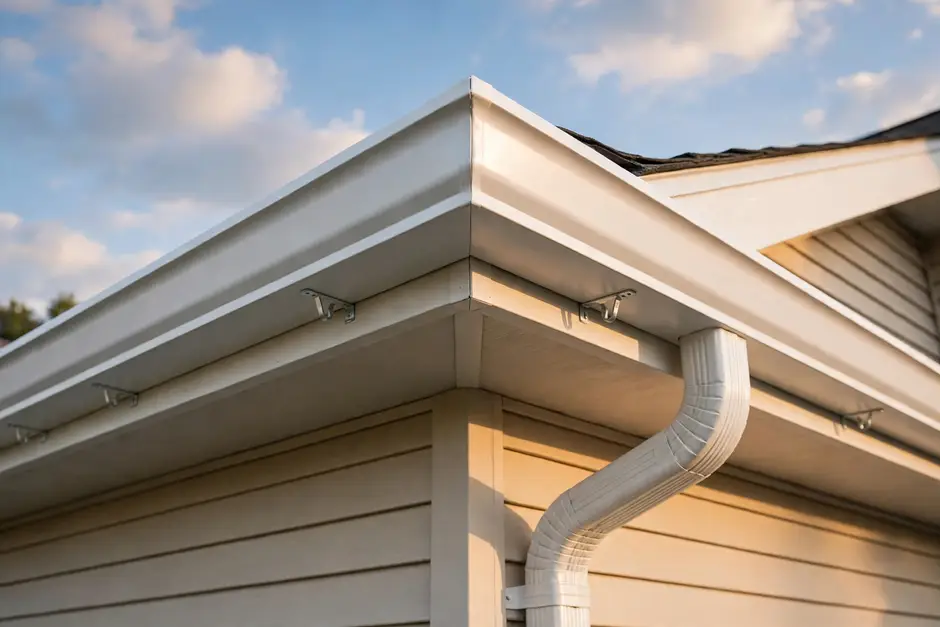
Gutter Repair
Leaks, sagging runs, rust, and pitch problems put right.Gutter Cleaning
Debris removal and downspout clearing to keep water moving.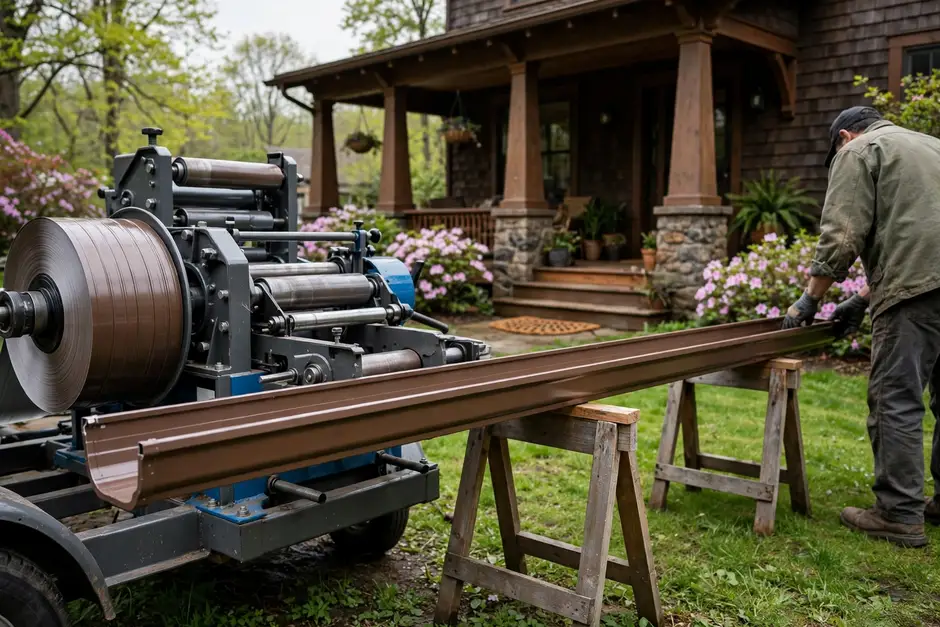
Gutter Guard Installation
Mesh, screen, and solid-cover guards that cut down debris.Copper Gutters
Copper and half-round systems for older and historic-style homes.Downspout Installation
Downspouts, extensions, and discharge that moves water from the wall.
Fascia and Soffit Repair
Fascia and soffit repair where damage sits behind the gutter.Ice Dam Prevention
Prevention measures and heat cables before winter ice forms.
Commercial Gutter Services
Gutter systems for commercial and multi-unit buildings.Ready when you are
Seamless Gutter Installation — Call to Discuss Your Roofline
Call (317) 953-7363 during business hours to talk through a new seamless system or a replacement. Monday through Friday 8 AM to 6 PM, Saturday 10 AM to 12 PM, Sunday closed.
Talk with the local team
Request Seamless Gutter Installation
Call (317) 953-7363 during business hours to discuss a new seamless system or a replacement. You can also reach us through the contact page. Indianapolis service areas are listed on the locations page. Office hours are Monday through Friday 8 AM to 6 PM, Saturday 10 AM to 12 PM, and Sunday closed.